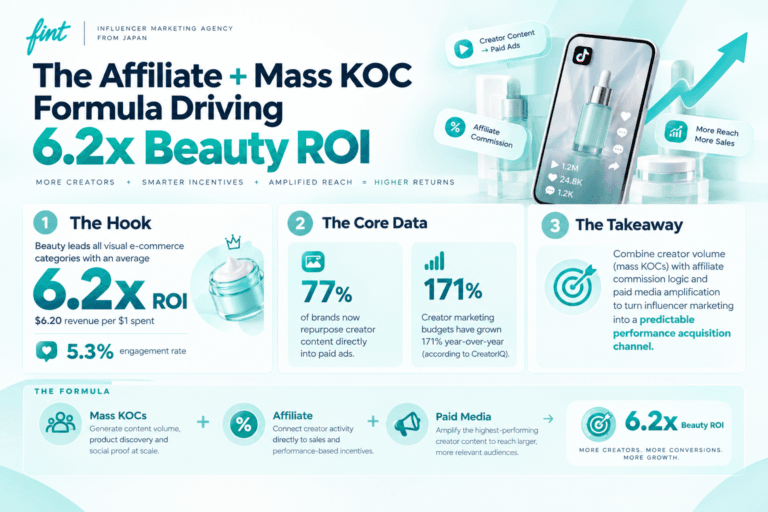
For beauty brands entering Vietnam’s competitive social commerce landscape, one question dominates planning discussions: How many KOCs do we actually need?
The answer has shifted dramatically. In 2026, industry benchmarks suggest that seeding fewer than 500 creators per quarter now puts a brand at a structural disadvantage, while leading global beauty brands are operating at 1,000+ creator programs . The Vietnamese market, with its trust-driven consumer behavior and platform-specific dynamics, demands a strategic approach to volume.
The 2026 Landscape—Why Volume Matters
1.1 The Global Threshold: 1,000 Creators Per Quarter
The competitive bar has risen significantly. With over 30,000 beauty brands now operating on TikTok Shop globally, a 100-creator-per-quarter seeding program is “no longer visible in category feeds” . Brands seeding fewer than 500 creators per quarter are considered “structurally underscaled for 2026 beauty competition” .
The industry’s top performers—brands like Rhode, Merit, and CeraVe—now operate at the 1,000+ creator threshold per quarter .
1.2 The Vietnam Market Context
Vietnam’s beauty market operates on a trust-driven social commerce model:
-
Over 77% of Vietnamese consumers have purchased a product because of influencer recommendations
-
Brands are increasingly investing over 30% of their marketing budget in influencer marketing
-
KOC campaigns typically deliver 5–15% engagement, compared to 1–3% for traditional KOL posts
The math is clear: volume drives visibility, and visibility in Vietnam’s crowded beauty feed requires a substantial creator base.
1.3 The Tiered Creator Stack
Based on global benchmarks, a competitive 90-day creator stack should follow this structure :
| Tier | Number | Role |
|---|---|---|
| Micro-creators (10K–250K) | 750+ | Volume and authenticity |
| Mid-tier (250K–1M) | 200+ | Scale and credibility |
| Skinfluencers/Dermfluencers | 30+ | Authority and trust |
| Celebrity/Mega | 10+ | Broad reach |
At least 250 products should be seeded per month to maintain content velocity .
Section 2: Vietnam Case Studies—What Success Looks Like
2.1 FinT Vietnam x Biore: 663+ Creators Across Three Products
FinT Vietnam’s campaign for Biore, a flagship brand of Kao Corporation, demonstrates the power of product-specific KOC strategies .
Campaign Structure:
-
UV Smooth Velvet Sunscreen: 239 creator posts, 60% from micro-KOCs
-
Biore MUR: 168 influencer videos
-
UV Aqua Rich: 256 influencer videos
Total: 663+ creator videos generating over 20 million views and 16,000+ engagements .
Key Numbers:
| Product | Videos | Views | Engagement Rate | Sentiment |
|---|---|---|---|---|
| UV Smooth Velvet | 239 | 7.1M | 3.59% | 95% positive |
| MUR | 168 | 3.49M | — | Strong purchase intent |
| UV Aqua Rich | 256 | 10.17M | 3% | Above benchmark |
Strategic Insight: FinT approached each product as a unique campaign, with niche targeting for UV Smooth Velvet (#chongnangkiemdau), trust-building for MUR, and mass-market scale for UV Aqua Rich
2.2 FinT Vietnam x COSRX: Two-Phase Awareness Campaign
For COSRX’s product launch in Vietnam, FinT executed a two-phase strategy that combined top KOLs with 30 UGC creators .
Phase 1: Top Skincare Experts
-
4 selected KOLs (including Thao Doan with 1.3M followers)
-
Results: 1,195,831 views, 4.46% engagement rate, 21.1% above channel average
Phase 2: UGC Scale-Up
-
30 UGC creators focused on authentic, relatable content
-
Results: 707,353 views, Cost Per Engagement: 161 VND (vs. 6,456 VND in Phase 1)
Strategic Insight: The UGC phase was 40x more cost-efficient per engagement while still generating substantial reach .
2.3 FinT’s Network Scale
FinT Vietnam manages a network of 10,000 influencers ranging from macro to nano, with a track record of supporting over 300 clients and campaigns for brands including COSRX, Biore. For a brand entering Vietnam, this scale enables rapid campaign deployment and access to a tiered creator stack .
Section 3: How to Determine Your Campaign Size
Tier Mix Considerations
For a conversion-focused campaign in Vietnam, the tier mix should consider:
| Tier | % of Campaign | Rationale |
|---|---|---|
| Nano (1K–10K) | 36–40% | High authenticity and engagement |
| Micro (10K–50K) | 45–50% | Scale + credibility + cost-efficiency |
| Mid-tier (50K–300K) | 10–15% | Reach amplification |
| Macro (300K+) | 3–5% | Authority and mass visibility |
The Biore campaign’s 60% micro-KOC allocation mirrors this logic, prioritizing authenticity and cost-efficiency while still achieving scale .
3.3 Budget Benchmark
Based on Vietnamese KOC rates from ArgoHub campaign data :
-
Test/Pilot (30 creators): 150 million VND (over $5,000)
-
Mass Campaign (300+ creators): 1.0–1.5 billion VND ($40,000–60,000)
-
Full Entry (500+ creators): 2+ billion VND ($80,000+)