Executive Summary: The ROI Mandate
Influencer marketing has evolved from a brand awareness tactic into a measurable ROI channel that can compete with traditional media for budget allocation. For beauty brands in Vietnam—from K-beauty leaders like COSRX and Torriden to global names entering the market—the question is no longer if influencer marketing works, but how to optimize it for maximum return.
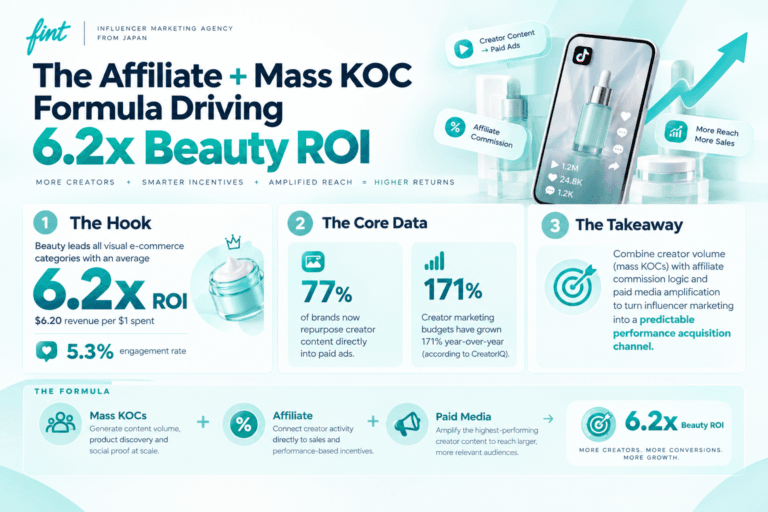
Recent industry research confirms that influencer marketing delivers exceptionally strong performance in the beauty and specialty retail sectors, and 75% of brands still have room to scale their creator investment for additional growth . For B2B managers at corporate beauty brands, this represents an opportunity to move beyond engagement metrics and build creator strategies based on measurable business outcomes.
Why Influencer Marketing is Now a Direct Revenue Driver
1.1 Beyond Engagement: The Shift to Performance Measurement
Traditional metrics—likes, comments, and follower growth—no longer justify influencer budgets. Circana’s 2026 research demonstrates that influencer activity can now be measured against other media channels using sales impact and incrementality, enabling brands to compare creator performance directly against TV, digital display, and search advertising .
For beauty brands, this is transformative. Beauty products are “experience goods”—consumers need to see, understand, and trust a product before purchase. Creator content bridges this gap more effectively than static advertising because it provides social proof, demonstration, and authentic storytelling .
1.2 The Vietnam Market Context
Vietnam’s e-commerce market is growing at a projected CAGR of 35% (2024-2028), with the beauty sector alone generating 36,500 billion VND in transaction value on e-commerce platforms . K-beauty brands have been at the forefront of this growth:
-
COSRX achieved Amazon’s Choice status with 60,000+ 5-star reviews, while its #SnailMucin hashtag surpassed 1.2 billion views on TikTok .
-
Torriden scaled from an organic creator post by Jessica Vu to a 400+ store Sephora rollout by 2025 .
-
Shopee Vietnam reported K-beauty orders grew 5.2x between 2021-2023, with COSRX and Peripera sales doubling year-over-year .
Section 2: Key Data Points—Proving Influencer ROI for Beauty Brands
2.1 The Circana Findings: Quantifiable Business Impact
Circana’s Value of Influence report (2026) provides the most robust framework for measuring influencer ROI:
| Metric | Finding |
|---|---|
| Beauty sector performance | Influencer marketing delivers exceptionally strong ROI in beauty and specialty retail |
| Scale potential | 75% of brands have room to increase influencer investment |
| Measurement capability | Brands can now measure incremental sales lift and compare against traditional media |
| SMB advantage | Small and mid-sized brands often see stronger returns from creator campaigns |
For B2B managers, this means: Influencer marketing is not a “nice-to-have” but a measurable investment channel with proven ROI, particularly for beauty brands in high-growth markets like Vietnam.
2.2 Vietnam-Specific Performance Examples
Case Study: Cavaillès on TikTok Shop
This premium personal-care brand achieved a 7.2x ROI and 1.7x GMV growth during the Mega Sale season by combining creator content with platform automation. Their strategy involved:
-
Partnering with creators to highlight product benefits authentically
-
Using Auto Remix to convert livestream moments into short-form ads
-
Leveraging Promo Days to automatically adjust ROI targets when buyer intent peaked
The result: 2.6% CTR and successful elevation of an emerging SKU into a hero product .
Case Study: Dove Scrub’s ’52 Friyays’ Campaign
Dove Scrub Vietnam transformed a functional product into an emotional “reset button” through a year-long influencer strategy:
-
58,000+ pieces of content created
-
60%+ sales growth
-
345% increase in search volume
-
Achieved #1 market share on digital commerce platforms
This demonstrates the power of behavioral ritualization—embedding a product into consumers’ weekly routines through consistent influencer advocacy.
Section 3: Platform Strategy for the Vietnamese Beauty Market
3.1 TikTok: The Discovery Engine
TikTok is the primary platform for beauty discovery in Vietnam. 93% of Indonesian beauty users take action after watching beauty content, and Vietnam’s figures are comparable . Key strategies:
-
Hashtag challenges: COSRX’s #SnailDuoShot challenge reached 100 million views in one month .
-
Livestream commerce: TikTok Shop enables creators to sell directly during streams, shortening the purchase funnel.
-
Affiliate creatives: Brands like Cavaillès partner with creators through open-plan affiliate programs to scale content production .
3.2 Facebook: The Validation Space
Facebook serves as the “confidence confirmation” platform—where consumers research product reviews, join beauty communities, and validate purchase decisions .
3.3 Instagram: Aspirational Positioning
Instagram remains the preferred platform for premium beauty brands to showcase lifestyle positioning . For affluent Vietnamese consumers:
-
Hannah Nguyen brings 15+ years of professional beauty experience, building credibility for premium skincare .
-
Meichan bridges beauty and academic achievement (Yonsei University student), creating aspirational appeal for K-beauty products .
Section 4: Creator Tiers—Strategic Selection for B2B Managers
4.1 Nano & Micro-Influencers: High Engagement, Optimal ROI
Research shows 44% of businesses prefer Micro/Nano-influencers for higher engagement and optimal ROI . For beauty brands, these creators deliver:
-
Higher trust: Recommendations feel more authentic than celebrity endorsements
-
Better fit: Expertise (EX) and information authenticity (AU) are key drivers of consumer trust and purchase intention
-
Cost efficiency: Lower fees with comparable or better engagement rates
4.2 Macro-Influencers & KOLs: Scale and Credibility
KOLs remain valuable for product launches and brand awareness campaigns. The job market for influencer partnerships reflects this: leading agencies like WPP Media are hiring Manager-level roles to develop influencer strategies with clear rationale on tribe, tier, content angle, and the role of influencer within the broader communication ecosystem .
Section 5: The COSRX & Torriden Playbook—What B2B Managers Can Learn
5.1 Consumer Language vs. Brand Language
The top 5 K-beauty brands on Amazon- COSRX, Medicube, Beauty of Joseon, d’Alba, and Torriden—share a common success pattern:
“They spoke in consumer language, not brand language.”
-
COSRX didn’t say “Snail Mucin Technology.” They said: “Next-day results for troubled skin.”
-
Torriden didn’t say “Advanced Functional Serum.” They said: “For people whose skin barrier has been damaged.”
For Vietnam: Vietnamese consumers are increasingly sophisticated. Premium beauty buyers want products that solve specific problems—not just generic claims. Creator content must translate technical product attributes into relatable consumer benefits.
5.2 Scaling Through Reviews and Social Proof
COSRX built its Amazon dominance through volume of reviews + ingredient transparency—6,000+ 5-star reviews and Amazon’s Choice badge . This same principle applies to Vietnam’s e-commerce platforms: creators who generate authentic, detailed reviews build the social proof that drives mass-market adoption.
5.3 Platform-Specific Virality
-
TikTok: “Beauty brands need to collaborate with trustworthy influencers and actual users of the product to develop convincing content”
-
Facebook & YouTube: Longer-form reviews and tutorials support considered purchase decisions for premium products
Section 6: Regulatory Context—Decree 87 and Influencer Accountability
Decree 87/2026/ND-CP, effective May 15, 2026, imposes stricter regulations on social media advertising in Vietnam :
| Key Provision | Impact |
|---|---|
| Penalties up to 100M VND (individuals) / 200M VND (organizations) | False advertising, misleading product claims now carry severe financial consequences |
| “Only review after using the product” requirement | KOLs must have actual product experience before endorsing |
| Stricter legal clauses in contracts | Brands and agencies adding compliance clauses to mitigate risk |
B2B Manager Implications:
-
Prioritize influencers with product expertise (e.g., Hannah Nguyen’s 15+ years in beauty)
-
Require documentation: Brands should provide legal paperwork and product testing data
-
Value credibility over reach: KOLs with a “clean image” and high credibility are now more valuable than those with large but low-engagement audiences
Section 7: Strategic Recommendations for B2B Managers
7.1 Budget Allocation
-
Scale influencer investment: With 75% of brands under-investing, there is opportunity for first-mover advantage
-
Diversify creator tiers: Combine Macro-influencers for awareness with Micro/Nano for conversion
-
Test before scaling: Validate content angles with small creator groups before large-scale seeding
7.2 Measurement Framework
-
Move beyond vanity metrics: Use incremental sales lift, not just reach and engagement
-
Compare against traditional media: Circana’s methodology enables direct comparison with TV, digital display, and search
-
Track full-funnel performance: From discovery (TikTok) to validation (Facebook) to purchase (Shopee/TikTok Shop)
7.3 Creator Selection Criteria
| Criterion | Why It Matters |
|---|---|
| Expertise (EX) | Influencers with product knowledge drive higher trust and purchase intention |
| Information Authenticity (AU) | Content must feel real, not overly commercial |
| Fit (FIT) | Similar physical traits (skin/hair type) increase perceived product relevance |
| Professional credibility | Creators like Hannah Nguyen (15+ years experience) build confidence for premium products |
7.4 Platform Priorities
-
TikTok: Primary channel for discovery and impulse purchases
-
Instagram: Aspirational brand positioning for premium products
-
YouTube: Long-form reviews for considered purchases
-
Facebook: Community building and purchase validation
Section 8: Frequently Asked Questions (FAQs)
Q1: How do I justify influencer marketing spend to senior leadership?
A: Use the Circana framework: measure influencer campaigns against other media channels using incremental sales lift and ROI, not just engagement metrics. Beauty brands can achieve ROI comparable to or exceeding traditional media, with 75% of brands still having room to scale for additional growth .
Q2: What ROI can I realistically expect from influencer campaigns in Vietnam?
A: While results vary, brands like Cavaillès achieved 7.2x ROI and 1.7x GMV growth on TikTok Shop during Mega Sale periods . Dove Scrub delivered 60%+ sales growth and a 345% increase in search volume through consistent year-long influencer engagement .
Q3: How do I adapt my influencer strategy?
A: Prioritize influencers with product expertise, require them to test products before reviewing, and include stricter legal clauses in contracts. Focus on creators with a “clean image” and high credibility rather than just follower count.
Q4: Should I prioritize TikTok or Facebook for beauty influencer marketing?
A: Both are essential for different funnel stages. TikTok drives discovery and impulse purchases. Facebook serves as the “confidence confirmation” channel where consumers validate purchase decisions. Multi-platform strategies combining both deliver the strongest results .
Q5: What’s the most effective creator tier for a premium beauty brand?
A: A tiered approach works best:
-
Macro/KOLs for brand awareness and product launches
-
Micro-influencers (10K–100K followers) for high engagement and trust
-
Nano-influencers (1K–10K followers) for authentic, community-driven recommendations
For premium brands, expertise and authenticity matter more than reach—consumers with higher disposable income are more sophisticated and value credibility .
Q6: How can I measure the incremental impact of influencer marketing?
A: Use advanced marketing mix modeling (MMM) combined with proprietary retail data to quantify short-term sales impact and long-term brand contribution. This allows direct comparison of incremental sales lift against TV, digital display, and search advertising .
Conclusion: The Roadmap Forward for B2B Beauty Managers
The data is clear: influencer marketing is a proven ROI channel for beauty brands in Vietnam. With the market growing rapidly, K-beauty brands dominating, and regulatory changes raising the bar for quality, B2B managers who treat influencers as a performance channel—not just an awareness tool—will capture the most value.
Key Action Items
-
Move to performance-based measurement: Track incremental sales, not just engagement
-
Invest in creator education: Help influencers become genuine experts to build consumer trust
-
Stay compliant: Adapt to Decree 87 by prioritizing credible, product-tested creators
-
Scale thoughtfully: 75% of brands under-invest—there is room for well-executed strategies
-
Learn from K-beauty success: Speak in consumer language, validate content angles before scaling, and understand platform-specific virality mechanics