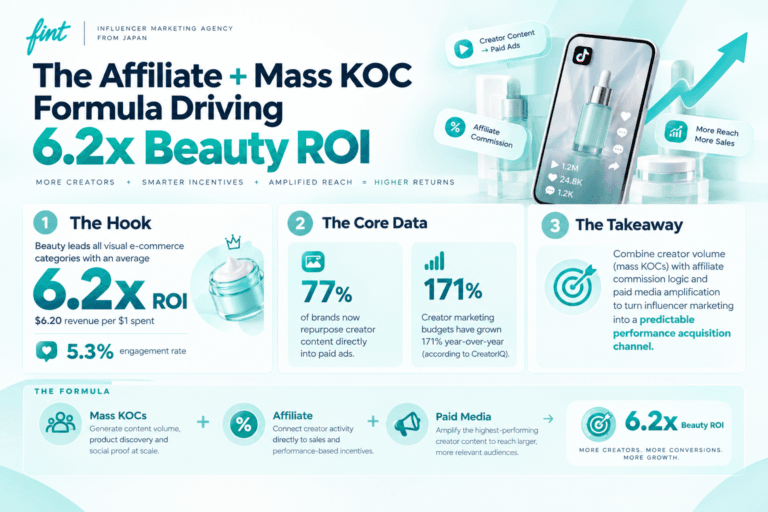
The Crisis of Trust in Social Commerce
Vietnam is experiencing what experts call a “trust crisis” in social commerce. Despite soaring budgets and record-breaking view counts, conversion rates for many campaigns have hit rock bottom . Consumers can now detect “template reviews” within seconds—when a KOC reviews cosmetics, supplements, and household goods from the same bedroom with ring-light setup, authenticity is completely destroyed .
What this means for Japanese brands: Your competitive advantage—Japan’s reputation for quality and safety—must be activated through trusted voices. Consumers want real experiences, not scripted advertisements.
Social Commerce: Where Discovery Meets Purchase
Vietnam already makes up approximately 57% of the Southeast Asian cosmetics market, surpassing Thailand, Malaysia, the Philippines, and Singapore combined . This growth is driven by Gen Z and millennials—social media natives shaped by viral beauty trends and e-commerce .
Platforms like TikTok Shop and Shopee Live dominate this space, where users watch influencers test products in real time and click “buy” instantly . Over 90% of influencer marketing campaigns in Vietnam now focus on TikTok and Facebook .
2026 Trends Reshaping Vietnam’s Influencer Strategy
1. The End of the “Script Reader” Era
The traditional formula—send products in bulk, send a script, KOC films at home, link for sales—is obsolete . Consumers have developed a “defensive barrier” against promotional content, asking: “They’re advertising, not sharing” .
Strategic response: Market leaders are pivoting to experiential content. Programs like “Creator For Vietnam” (CFV) take KOCs to farms and factories, creating authentic, evidence-based content . When KOCs witness quality control processes firsthand, the resulting emotions cannot be faked—and content becomes naturally persuasive .
Case study: Traphaco’s CFV program brought KOCs to Sapa to experience Atiso ingredient sourcing firsthand—transforming creators from “script readers” into genuine brand ambassadors .
2. The “Authenticity Premium” in the AI Era
As AI-generated content floods platforms, consumers actively seek real human voices. “Mid-fi” content- behind-the-scenes footage, genuine testimonials, unfiltered moments—will outpace polished productions .
Strategic implication for Beauty Brands: Showcase your manufacturing processes, ingredient sourcing, and authentic team stories. Japanese precision and quality standards are powerful storytelling assets, but they must feel human, not corporate.
3. Micro-Influencers: Superior Engagement
Micro-influencers (1,000-10,000 followers) deliver significantly higher engagement rates than mega-influencers . Their communities are more cohesive, creating feelings of familiarity and trust .
Why this matters for beauty brands: 44% of businesses now prefer micro or nano-influencers for optimal ROI . Research confirms that micro-influencer expertise, authenticity, and “fit” with consumer needs directly reduce perceived risk and build trust—the key drivers of online purchase intention .
4. Knowledge-Based Livestreaming: The Blue Ocean Strategy
While most livestreamers compete on price and promotions, a new model is emerging: expert-led livestreaming.
Case study: Hannah Olala (Hannah Nguyễn), with over a decade of experience as Group Brand Manager for international cosmetics and General Manager at VinDS Beauty, built a premium cosmetics business on Shopee through knowledge-based livestreaming . Instead of pressure sales tactics, her sessions focus on ingredient analysis, product mechanisms, and skincare routines in accessible language. In 2025, she received Shopee’s “Best Premium Livestream Star” award and became the first Vietnamese speaker at Shopee’s Brand Summit in Singapore .
Strategic implication: Japanese beauty brands can leverage their scientific formulation expertise—training knowledgeable KOLs to deliver credible, educational content that builds trust.
5. Platform Diversification Beyond TikTok
Gen Z and Gen Alpha are migrating to closed ecosystems like Discord, Substack, and Patreon . Relying on a single platform is increasingly risky. Brands need to expand into spaces where they control user data and engagement .
New Regulations: Compliance Is Non-Negotiable
Amended Advertising Law 2026 (Effective January 1, 2026)
Vietnam’s Amended Advertising Law formally introduces “Advertisement Conveyors” as distinct legal participants—capturing KOLs, KOCs, and social media personalities .
Key obligations for influencers :
-
Verify advertiser credibility before accepting engagements
-
Review and verify product documentation
-
Personally use products before recommending them
-
Disclose sponsorship immediately before and throughout content
Decree 87/2026 Penalties
| Violation | Penalty |
|---|---|
| Promoting products without researching/understanding them | 80-100 million VND ($3,200-$4,000 USD) |
| Failing to disclose advertising status | 60-80 million VND |
| Using misleading claims for cosmetics | Up to 40 million VND |
| Using images of doctors/medical staff to advertise cosmetics | 15-20 million VND |
Additional consequence: Violating influencers must issue a public written apology to consumers .
The “Clean Record” Requirement
Brands now require “background checks” on influencers before contracts. Past scandals, controversial statements, and crisis response history are treated as financial risks . Many contracts include clauses allowing termination if the influencer becomes embroiled in ethical controversy during the campaign .
What this means for Japanese brands: Review influencer contracts to include compliance obligations, risk allocation clauses, and termination rights. Compliance training for influencers is essential.
Strategic Framework for Japanese Beauty Brands
Phase 1: Partner Selection & Vetting
Do:
-
Prioritize “clean records”: Review the influencer’s history of statements, past controversies, and crisis response capability
-
Verify engagement quality: Examine comment sections for genuine conversations vs. generic responses
-
Consider regional cultural alignment: Vietnam has distinct dialects and sensibilities across North, Central, and South regions
Don’t:
-
Base decisions solely on follower counts
-
Skip the verification process
Phase 2: Campaign Design & Content Strategy
Do:
-
Create experiential campaigns: Take influencers to factories, farms, or HQ for evidence-based content
-
Empower KOCs to be genuine: Trust their authentic voices over rigid scripts
-
Consider knowledge-based livestreaming: Leverage product expertise for educational content
Don’t:
-
Send only products and scripts without experiential elements
-
Ignore regional differences in messaging
Phase 3: Compliance & Risk Management
Do:
-
Include compliance clauses in influencer contracts
-
Educate influencers on disclosure requirements
-
Monitor campaign performance and influencer behavior
Don’t:
-
Assume influencers understand regulations—provide training
-
Wait until after a violation occurs to implement monitoring
Platform Selection Guide
| Platform | Primary Use | Best For |
|---|---|---|
| TikTok | Discovery, viral reach, short-form engagement | New launches, trend participation, livestream sales |
| Community building, deeper content | Brand storytelling, community loyalty | |
| Shopee/Lazada/Tiki | Direct conversion, social commerce | Purchase-driven campaigns, affiliate links |
Suggested FAQs
Q: What is the most effective influencer tier for beauty brands entering Vietnam?
A: A tiered approach works best. Micro-influencers (1,000-10,000 followers) deliver superior engagement and authenticity . 44% of businesses prefer micro/nano-influencers for optimal ROI. For market entry, use micro-influencers for authentic reviews and a small number of macro-influencers for initial brand awareness .
Q: How should brands handle Vietnam’s new advertising regulations?
A: Vietnam’s Amended Advertising Law took effect January 1, 2026. Influencers must verify product documentation, personally use products before recommendation, and disclose sponsorship before and throughout content . Penalties range from 60-100 million VND ($2,400-$4,000 USD) . Review influencer contracts to include compliance obligations and risk allocation clauses.
Q: What’s changing about influencer marketing in Vietnam in 2026?
A: The biggest shift is the end of the “script reader” era. Consumers can now detect template reviews and are demanding authenticity . Successful campaigns are moving toward “Creator For Vietnam” style experiential content—taking influencers to farms and factories to create evidence-based content. Regulation is also tightening with the Amended Advertising Law .
Q: What platforms should beauty brands prioritize?
A: Prioritize TikTok for discovery and engagement, Facebook for community building, and e-commerce platforms (Shopee, Lazada, Tiki) for conversion. Over 90% of influencer campaigns in Vietnam focus on TikTok and Facebook .
Q: How should brands adapt to regional cultural differences in Vietnam?
A: Vietnam’s North, Central, and South regions have distinct dialects, humor, and values. Work with micro-influencers native to each region and tailor messaging accordingly. A campaign resonating in Ho Chi Minh City may need different storytelling in Hanoi.
Conclusion: A Mature Channel with Proven ROI
Vietnam’s influencer marketing ecosystem has evolved into a sophisticated channel delivering measurable business outcomes. For Japanese beauty brands, the opportunity is substantial:
-
Partner with micro-influencers and KOCs for authentic, high-engagement content
-
Create experiential campaigns that build evidence-based trust
-
Ensure regulatory compliance under Vietnam’s new advertising laws.
With Vietnam leading Southeast Asia’s cosmetics market and influencer campaigns increasingly linked to measurable sales, brands that act now will establish the relationships and trust necessary for long-term success.